
The process of making Maze is never straightforward or linear. However, in Unit 2, my troubles with technology were far fewer than they were in Unit 1. I was able to focus more on thinking about the work itself. Having made Part 1 in Unit 1, I was still thinking about where I could go with this project. Following feedback and advice, I was exploring artists like Ed Atkins and Quilla Constance, to see how I can make use of a single character to show different parts of my practice. At this point, I did not think of Maze as a continuous series exploring the same world. I was leaning more towards making work that is quite different but using the same character, Prota, who I built for Maze Part 1.
However, a tutorial with Paul Tarrago changed all of that. Paul told that Maze Part 1 felt like the beginning of something. When I explained the roots of Maze in the Cerebral Circus to him, he thought it made perfect sense and encouraged me to explore the world of the Maze further.
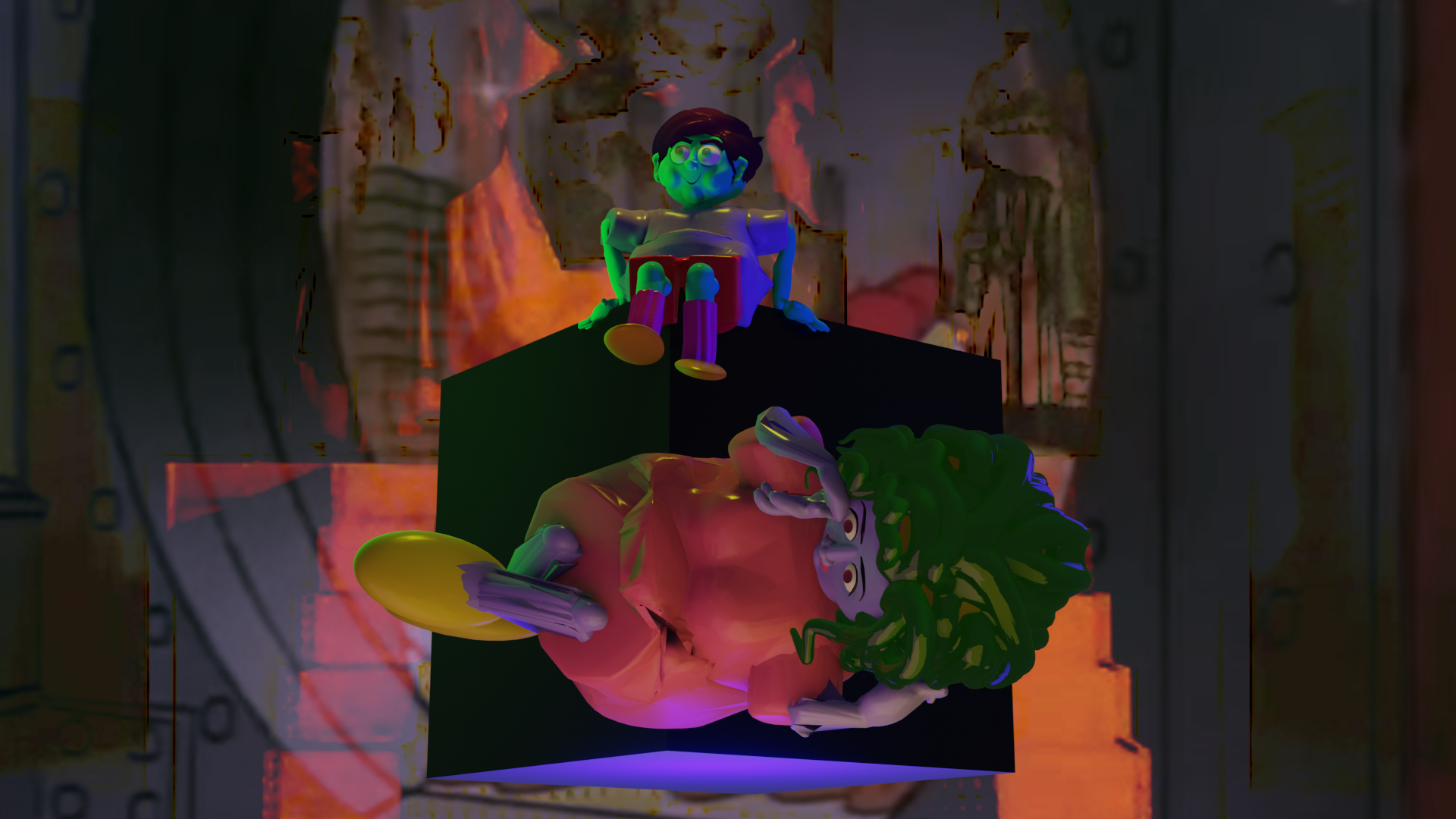
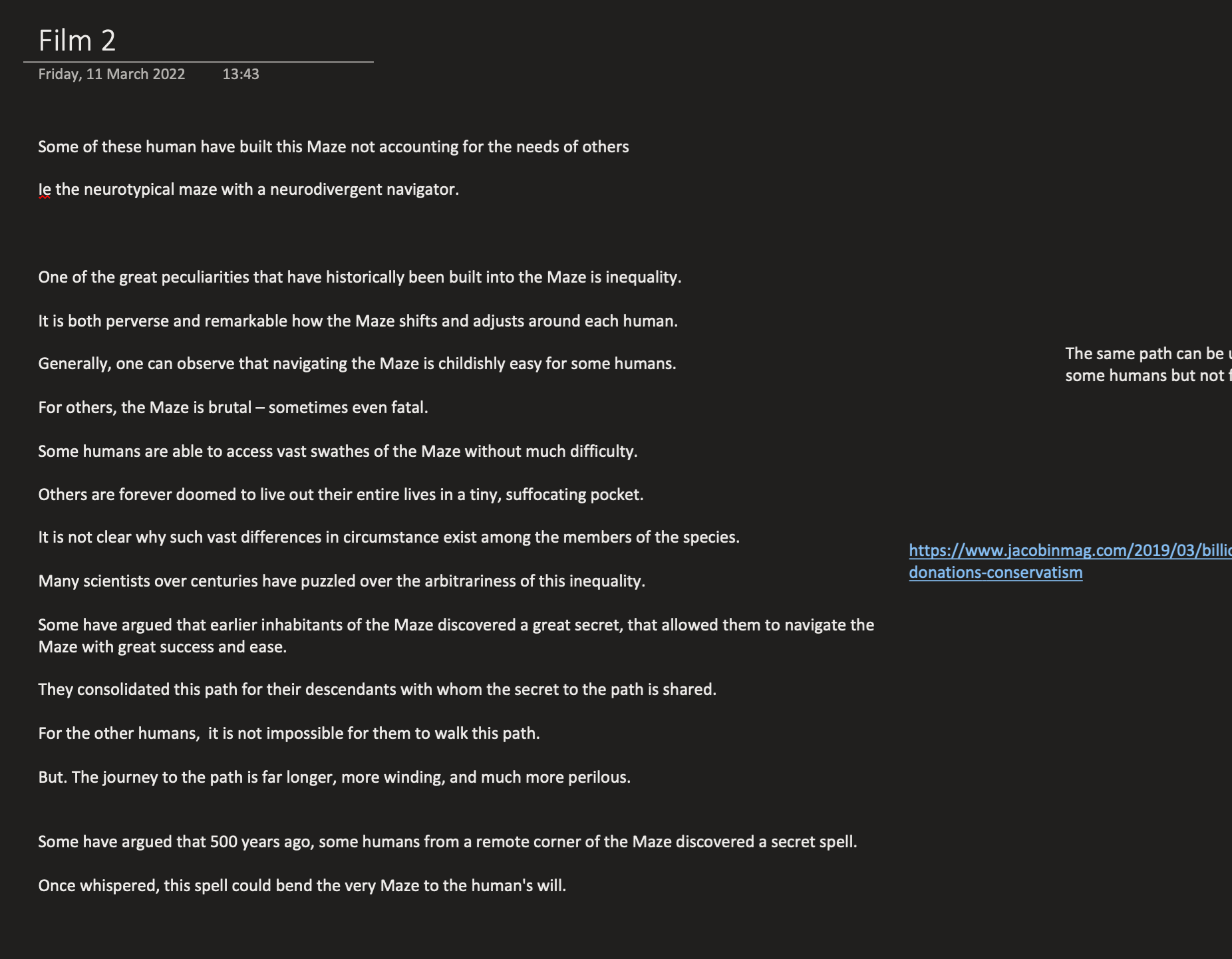
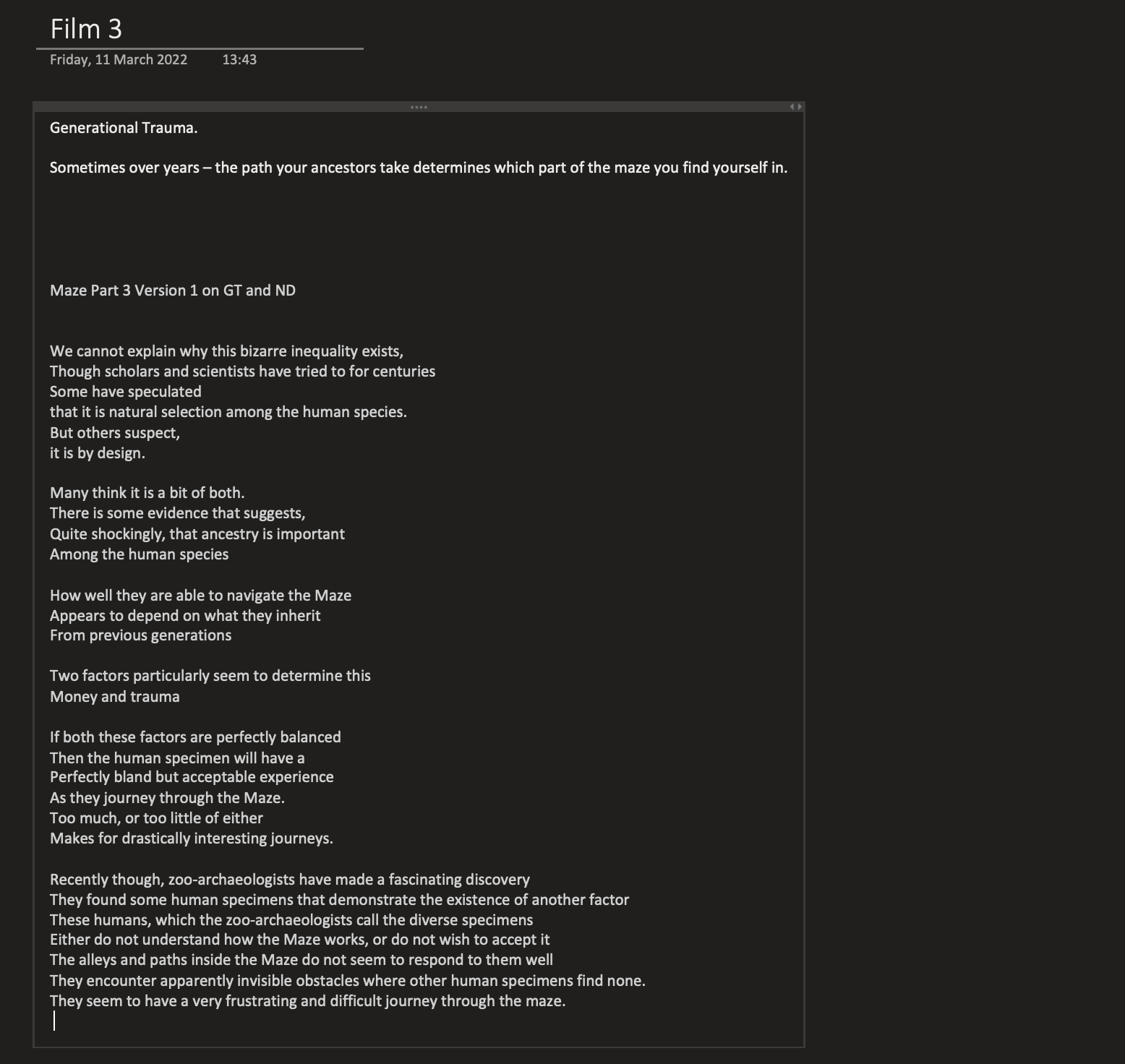
This proved to be quite fruitful in some time as I was able to write four more parts of Maze that seemed to bleed into each other quite organically. Each of these parts explores a different aspect of the experience of inequality. Maze Part 2 – The Mystery of Money, for instance, looks at material inequality. The subsequent parts look at neurodiverse experiences within a largely neurotypical system, the generational trauma resulting from colonialism, and the part it plays in defining present-day experiences for people of colour.
I revised the writing for Part 2 multiple times in order to arrive at a degree of clarity. This was harder than writing for Part 1, which came to me almost fully formed. I think writing Part two was harder because I was trying to condense a vast and entrenched financial system – parts of which are obscure or invisible to a layperson like myself – and then explain it through Werner Herzog's external gaze. The earlier drafts contained lines about how these financial systems did not always exist but have come to exist only in fairly recent history. And we think of them as normal now, even though they actively work against the interests of the public. This is really what I wanted to communicate with Maze Part 2, and though the final narration does not explicitly mention any sort of historicity, I think the idea of how ridiculous our financial systems are is communicated.
Using Archival Footage
One of the characteristic features of Maze is the use of archival footage. From my time as a historian, I have always loved engaging with archives. There is great thrill in finding obscure bits of people's lives and thoughts preserved onto pieces of paper. Even when I was working with the Economic and Political Weekly – which has an archive dating back to 1949 – working with the archive was a very rewarding part of my job. Maze Part 1 was the first video work that I have ever created and since then I have discovered that I really enjoy editing videos! I have come to think of archival footage as paint for my video canvas. Most of the background footage comes from hours spent trawling through the Moving Image Archive which has a rather eclectic collection of videos dating back to the late 19th Century. I usually try and find videos that will fit the narrative and add another layer of meaning to the work.
One of the characteristic features of Maze is the use of archival footage. From my time as a historian, I have always loved engaging with archives. There is great thrill in finding obscure bits of people's lives and thoughts preserved onto pieces of paper. Even when I was working with the Economic and Political Weekly – which has an archive dating back to 1949 – working with the archive was a very rewarding part of my job. Maze Part 1 was the first video work that I have ever created and since then I have discovered that I really enjoy editing videos! I have come to think of archival footage as paint for my video canvas. Most of the background footage comes from hours spent trawling through the Moving Image Archive which has a rather eclectic collection of videos dating back to the late 19th Century. I usually try and find videos that will fit the narrative and add another layer of meaning to the work.
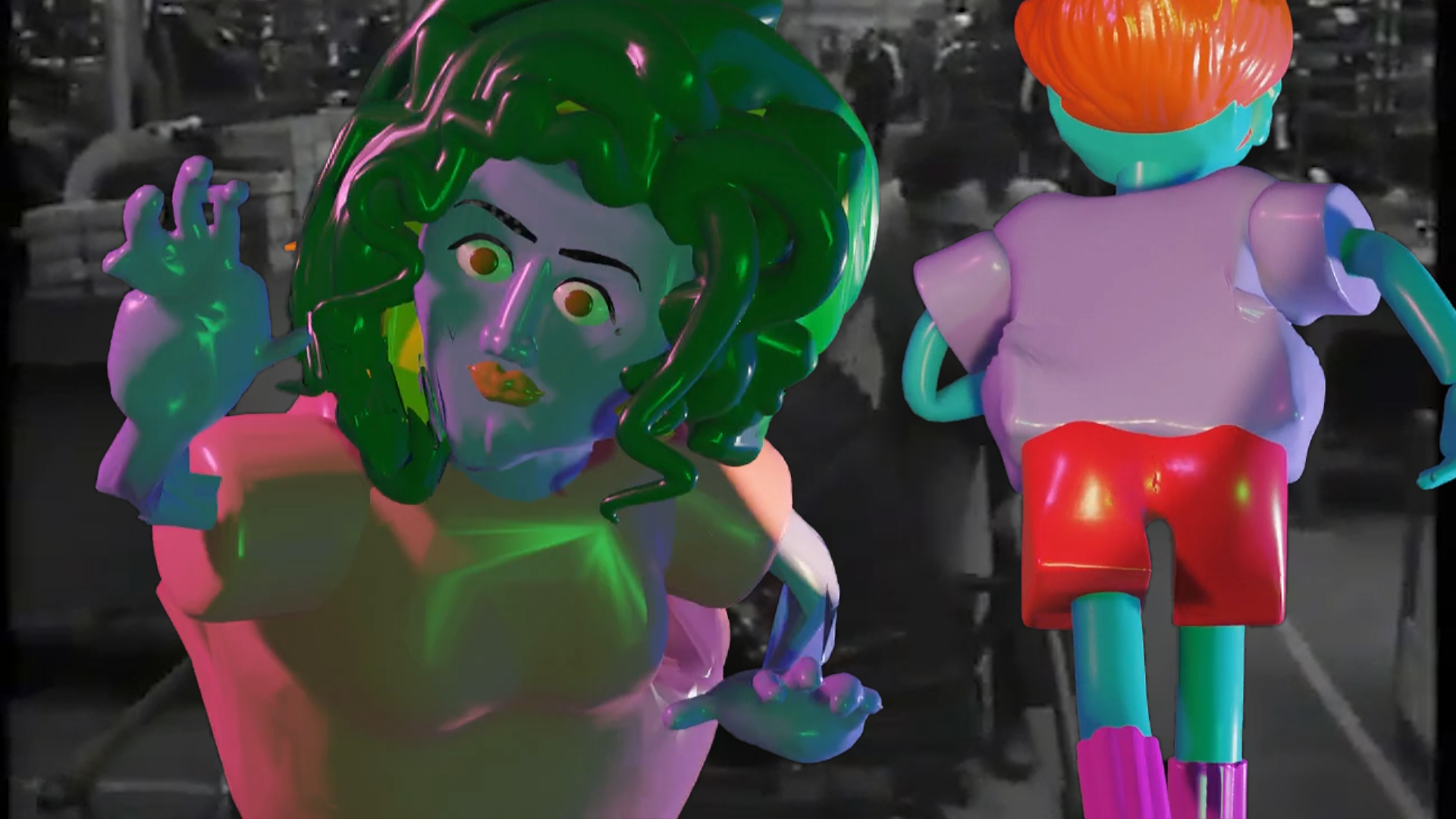
Visually, I think archival footage lends itself really well to the aesthetic of Maze, accentuating the feeling of exploring an alien world. I think I was drawn to using it in the first place because I was trying to communicate a sense of time and history through the narrative. Though there are parts in which I chose to use stock footage rather than archival footage, I find the archival footage more visually compelling.
Additionally, I also think it adds a bit of humour. There is something innately hilarious about footage from colonial India where white male narrators from the British Raj's propaganda machine try to show you the "orient" (see my favourite sample video on the right). Through a decolonial lens, the confidence and authority with which these narrators presented a reality they did not even remotely understand is comical now. Perhaps because with these videos, they were trying to sell a Maze of their own, or perhaps because the technology to produce these videos seem rather simple to us now, I find that the monochrome style of silent films and footage produced from the late 19th and early 20th century cannot be detached from a sense of light-hearted silly nostalgia.
Using Technology as a Medium
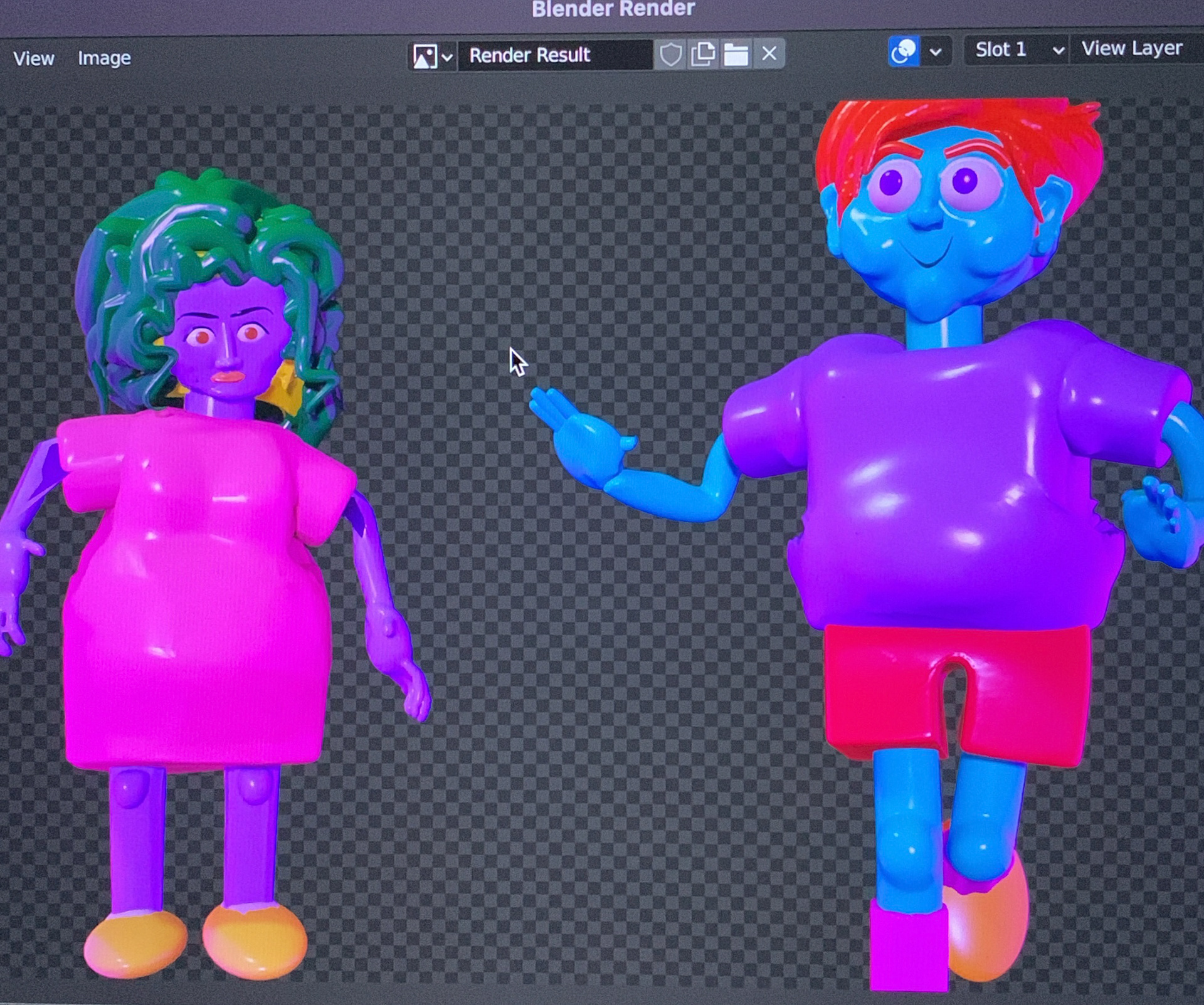
In Unit 1, I had encountered innumerable issues with the kind of software and technology that I was working with which had let to a lot of frustration. So in this unit, I simply assumed that the technology is never going to work the way you want it to. I decided instead to focus on the limitations of the medium and think about what it means for my practice. However, I did get better with Blender and learned how to work with materials. This is why Prota's hair looks almost glassy in some instances and the pupils of the characters are translucent and react to light. There were still a few issues here are there with the software not behaving as expected that I was not able to solve completely, but I found ways to work around them.
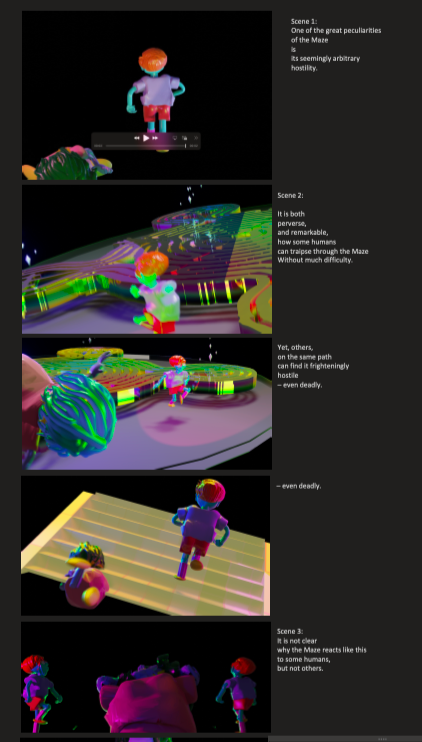
Seeing as I can only do a handful of animation sequences – designing a storyboard became a more circular affair with lots of back and forth, and discarding and reworking of scenes. Furthermore, there is little to no scope for working with facial animation with the kind of softwares I am using to animate my characters which led me to think of them as puppets! I understood that I have to design the characters as puppets and use body movements and exaggerated gestures to convey the emotional landscape of Maze. Some of the emotional reality of the characters needed to be worked within their design. For instance, the second character, Babloo, has a permanent smug grin on his face, whereas Prota looks more neutral and somewhat anxious.
Some of the movements I use are overly dramatic, and almost child-like. Prota is constantly falling, slipping, tripping, crawling, and showing other such depressing movements. Babloo, on the other hand, looks like a doll straight out of a Hollywood horror film. His poltergeist-ish grin and excessively energetic actions often disrupt Prota's path, but he carries on without care. His actions are in contrast to Prota's emotional reality because through his movements he tries to demonstrate ease and jubilance.
Some of the movements I use are overly dramatic, and almost child-like. Prota is constantly falling, slipping, tripping, crawling, and showing other such depressing movements. Babloo, on the other hand, looks like a doll straight out of a Hollywood horror film. His poltergeist-ish grin and excessively energetic actions often disrupt Prota's path, but he carries on without care. His actions are in contrast to Prota's emotional reality because through his movements he tries to demonstrate ease and jubilance.
For the world of Maze, I suspect that the exaggerated body movements certainly work better than pristine facial animation might. The movements echo the strange dysfunction of the Maze and visually lend to it a child-like simplicity – a simplicity that the narrative voice of Maze tries to communicate. It is the same sort of ethos with which a child might react to complex, trumped-up systems and practices that make no sense – with utterly brutal honesty and bewilderment.